



Simone Ashley swaps Bridgerton balls and the high fashion world of The Devil Wears Prada 2 for mind-bending thrills, chills and a touch of body horror gore with her latest leading role in This Tempting Madness, set to make its UK debut 10 August, courtesy of Plaion Pictures. Born from writer-director Jennifer E. Montgomery’s firsthand experience of tragedy, the film sees Ashley take the lead as Mia, a young woman who, after suffering a near-fatal fall, awakens from a coma with serious brain damage and amnesia. She spirals into insanity when she learns that her husband has been imprisoned for her attempted murder, leaving Mia to piece together her fragmented memories before she completely loses her grip on reality.
Director Jennifer E. Montgomery stopped by to chat with us about making the film.
Thank you for taking the time to chat with me. Today we’re talking about This Tempting Madness, which I loved. I’ve actually watched it twice in the space of a week, which I never normally do.
Oh, wow!
I believe this is inspired by true events. Can you talk about that and what made you want to tell this story?
Yeah, so unfortunately, this is something that happened to a very close friend of mine. It was obviously at the beginning of the film, she falls and has this horrible brain damage and she has to come back from the coma. And in going through this process with her, she had lost so much of her memory that it took a long time for her to regain memory of that last six months of her life. And it took a long time for her to even get to the point where she could have new short-term memory. But in that process, it became just so important having conversations with her, helping her walk through just the past six months of her life without imprinting too much onto her. And slowly things would come back, but the memories would come back in such fragmented ways, right? Like memory isn’t linear, memory isn’t so clean as to like when you picture maybe the most wonderful day of your life, you don’t picture 24 hours of that. You don’t even picture a whole hour. You feel that memory in the course of a second.
And so, as those memories come back to her, she would remember pieces of them, but she didn’t remember the entirety of them. And in that, it created a scenario where she was holding on to this very idealized version of her relationship that wasn’t real. And then other things would come up and she would hold on to these other things that just she would hold on that one piece that just made her feel guilty where she could then just blame herself for things. And so as she would revisit these memories and I would talk to her at different times and she would be in different, well, you’ve seen the film, and so don’t put the spoiler in, but as she would slip between personalities, the way she looked at it, the way her mind would let her remember things would be different. And she would just not ever have anything. Her mind was effectively erasing anything it didn’t want her to see. And that was a very strange experience to go through as her friend, but then of course also for her. And so, I had encouraged her to keep a journal in that time. At first she didn’t want to do it because she’s very much the kind of person who doesn’t like to do things for herself, but she’ll do things for other people. So, she was like, “why? I mean, are you going to make a movie of it?” And I was like, “no. I mean, do you want me to make a movie of it?” She was like, “yeah, yeah, yeah”. I’m like, “no, no, okay, fine. I’m gonna make a movie of it. Keep the journal”. I had no intention of making the movie and then as we got down the line and as she was recovered, she was like, “no, I really, I feel like you should do it. Are you going to do it?” And I was like, oh gosh.
I would talk to people about the story and I had so much support. She had so much support around her. I had so much support around me as we were going through this. And so many people were impacted by her story when I would recount it. So many people were amazed by it for so many different reasons because it’s dealing with a lot of difficult subject matter. It’s dealing with domestic violence. It’s dealing with mental illness. It deals with perception of memory. People were just constantly fascinated by the story. And so there was a point when I was like, okay, I mean, maybe, yeah, we should do this. If this is something you want to do and you’re comfortable with me telling your story and giving me the autonomy to do that, then I think a lot of people could learn a lot from it. So why not? And then on that, to that end, I had lived through it so intensely that I didn’t want to just, obviously not the way she had, but regardless, I didn’t want to just relive it in the realm of a drama over again. So, it was important to me to make it something more exciting and thrilling that I would want to engage with on a Friday night that was thrilling and has these sort of horror elements and just to keep the audience on the edge of their seat a little bit. And so doing it as a thriller genre or horror genre was important to me as well.
Oh, it’s definitely horror. It’s funny, I’ll go to a movie and I’ll watch something like Terrifier and not care about the gore, but there’s something about what happens in this movie where it’s like smaller, and it’s like the sound effects of like screws and things like that. I just had to turn away a couple of times. Why do you think whenever it’s the more intimate stuff that’s almost more horrifying than say massive buckets of blood?
Yeah, the psychological horror. I mean, I think that that’s, what’s so terrifying. And I think that was something that was so hard for her also is because there would be times when she would know she was missing a memory. It’s like, you’re so close to it and you can grasp it and then it just goes away. And I think there’s nothing more terrifying in the world than knowing your brain is playing tricks on you.
Yeah, definitely. I thought Simone Ashley was incredible. Why was she the perfect choice for Mia?
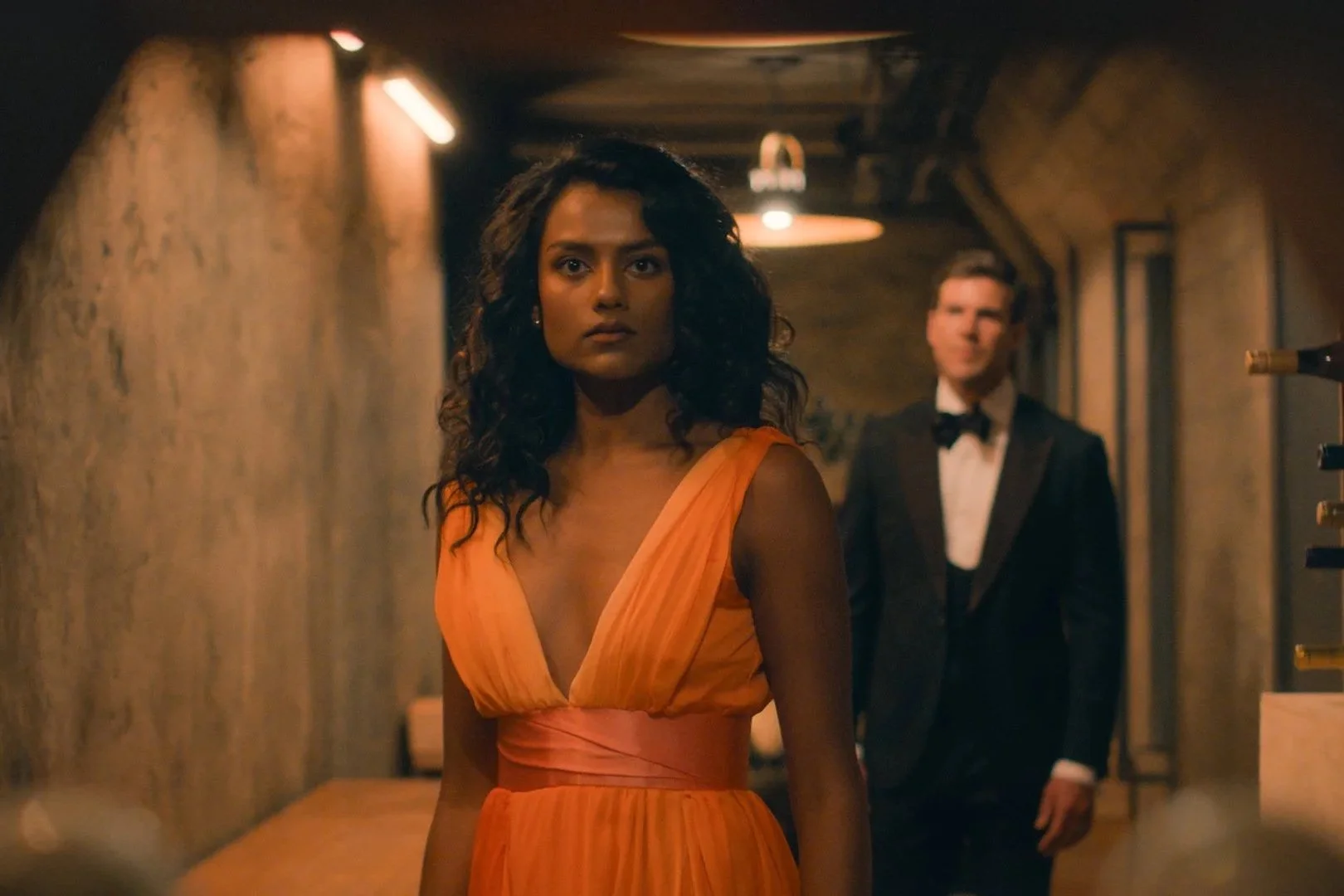
Yeah, we had a great script when we went out and so we got to meet with a lot of really amazing actresses, and it was tough cause there were so many really talented people. But when we sat down with Simone, she just so instantly had a picture for how she wanted to play the character that really was something I was looking for. And she specifically wanted to make sure that she was bringing strength to the character so that the character wasn’t just a victim but the character also sort of had her own fierce comeback. And that was something that was important to me as well because it took so much strength to heal from this. Even though it was a circumstance where you have someone in a coma, so much of it is also about her having the strength to heal both mentally and physically, even when it’s really tough. And it was always important that we make this a movie about someone, not about someone falling but about someone rising like a phoenix. That’s why she was perfect for the role because it was something she immediately tuned into and was really interested in that fierceness. That’s also something we just did in the design of the movie with the phoenix with the orange dress pluming and the wings and all of that. So yeah, Simone was great. She was also just, she’s such a fresh talent. It was so exciting to work with someone who had not worked in the genre before and sort of be able to play. I think that’s always really exciting as a director and as an actor.
Just going back to that opening scene, like they say in the screenwriting, the first 10 minutes should grab your attention, but this movie grabs it in the first 10 seconds because it starts off beautifully and all of a sudden she falls and it’s so horrifying. Can you talk about putting that scene together and just the emotions of creating that scene?
Yeah. No, I mean, that is very much like the thematic bookmark of the film. And so I talked a little bit about the dress and how we wanted it to emulate a phoenix and sort of lure you into this false sense of reality that maybe it is something beautiful. There’s this thing with adrenaline when you are in super intense moments where the mind just sort of slows down and what is really one second can feel like an eternity. And that is how people are able to get through a lot of things with adrenaline when they show superhuman strength in some way. At the point I knew I’d seen the footage of everything that had happened with Mia. I knew that she had been fighting really hard to not go over that railing and it took a long time for him to lift her and throw her over that railing. She had tons of adrenaline going into this moment. And then when she finally went over and was dropped, it was just, I wanted to capture that moment of like the shift of the fight is over, you’re just now in the fall. And then the realization of, okay, the fight isn’t just over now, I’m going to be hitting. And now there’s the horror of fall. But at first, I think that for me, I wanted to capture that sort of relief of the freedom from being out of the fight. And then, bring us straight back into how horrific the fall is. And we very much constructed it to be like the real fall and having, she hit her head here, she hit her head here, she ping-ponged between the escalators before she fell and landed in the net. And the film also has just incredible visuals throughout, but they all sort of help to show Mia’s mental state.
Can you talk about the use of visuals to progress the character?
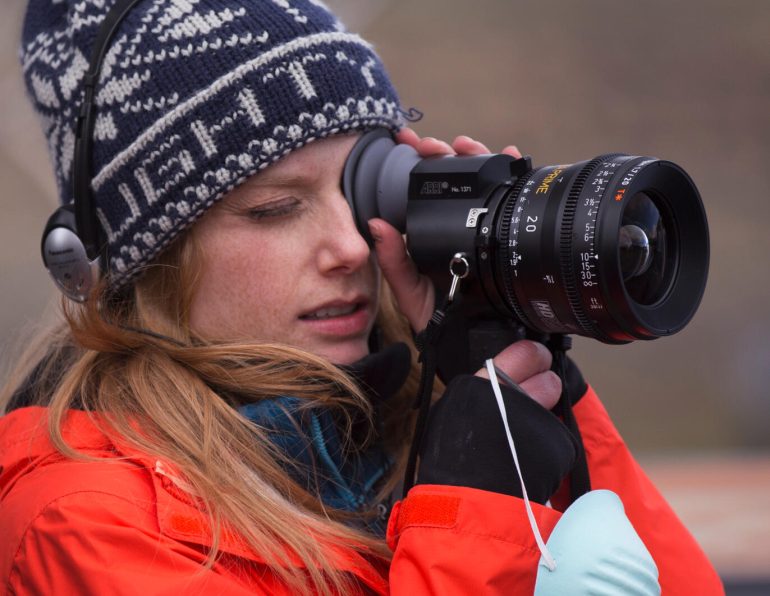
Yeah. So early in the film, we wanted to use restraint with the camera so that as we got deeper in the film and as her mental state was unraveling and coming to terms with things more, we could amp it up and put more motion into it and put more camera movement as she’s dealing with the internal strife more head on, the camera starts swinging back and forth, going up and down. And we wanted to hold back on that early on so that we could really go there in the end. And beyond that, we had different lens choices for her different mental states. So, when she was switching personalities, going in and out of her primary personality into this alter state, we specifically used what we coined the madness lens. And it’s this vintage Panavision lens. It’s very, very wide. And Simone would have to be super close to the lens. Like if this is the camera, this is her face. And we would keep it super close and then have her eye go just above the camera instead of, so it never spikes the camera, but it just sort of switches like her personality. And that was the device that we used throughout to indicate subtly to the audience something’s happening here with her mental state.
Following on from that, the music also really helps just creating this unsettling atmosphere throughout. Can you talk about working with composer Rebecca and creating the right musical sound for the film?
Yeah, Rebecca’s so talented. I was so excited to get her for this project. When we met with her, we really just wanted to create this organic sound. And I really wanted an organic score that would sometimes miss the difference between what a score and what a sound design and where they would sort of breathe into each other. And we also were looking for anything that could bring us more intensely into Mia, the character that Simone plays, Mia’s mind psychologically. And so as we were talking, she was like, “you know what? I have actually been working on this vocal organ for a while and inventing this new sort of instrument. And what if, I don’t know if your actress can sing at all, but if she could sing and we could capture her voice in just a few different notes, then I could attribute just tones of her voice to the voice organ and play her voice like a piano, like an organ”. So, we got really lucky because Simone is actually a very, very talented singer. She’s classically trained. And so, when this came up, we were like, oh, we know Simone can do this because of her voice. And so in ADR, we ended up having her sing two different scales. She hit those notes perfectly and then she not only sang the two different scales in just tones, I’m not going to sing it for you because I’m a terrible singer, but she got hitting the notes. And then she would go through and do it again with humming and then with a different sort of whispering. And so the composer then used those scales that we created from Simone’s voice, both of the tones and the notes, but also of the whispering and the hums to create what is the score of the music. So, the instrumentation of the music is made up almost entirely of Simone’s voice to help bring us closer into Mia’s character. And it’s grounded with this beautiful cello from Julia Kent. Then there are some other tonal things in there that we use a little bit interchangeably with sound design.
How would you like the film to resonate with audiences?
I love to hear when the film starts a conversation. There’ve been a lot of times when I’ve had people watch it and come up to me and say, “oh, this was so great”. Someone started talking to me after watching this movie with so-and-so, they started talking to me about a circumstance where they had started to feel hallucinations or where they had started to feel like they couldn’t trust their mind. And that’s always the kind of stuff you want conversations to be about so that it doesn’t get to the worst place, so that things can be dealt with early. And then also just so that people can understand. I like the idea of people understanding a little bit more what people go through when they’re in this kind of circumstance and why they sometimes act in ways we don’t understand. Because I think there are a lot of times that Mia makes choices that as the audience, you’re like, no, don’t do it. But she has reasons for doing it. And there’s an internal character logic as to why. I would love for people just to start a conversation about many of the things whether it’s domestic violence, mental illness, just the mental state of any of our own minds, we can all be prone to difficulties, so.
Thank you so much for taking the time to chat with me and all the very best with the film.
Yeah, of course, thank you. I can’t believe you watched it twice. That’s so exciting to hear. So, thank you.