


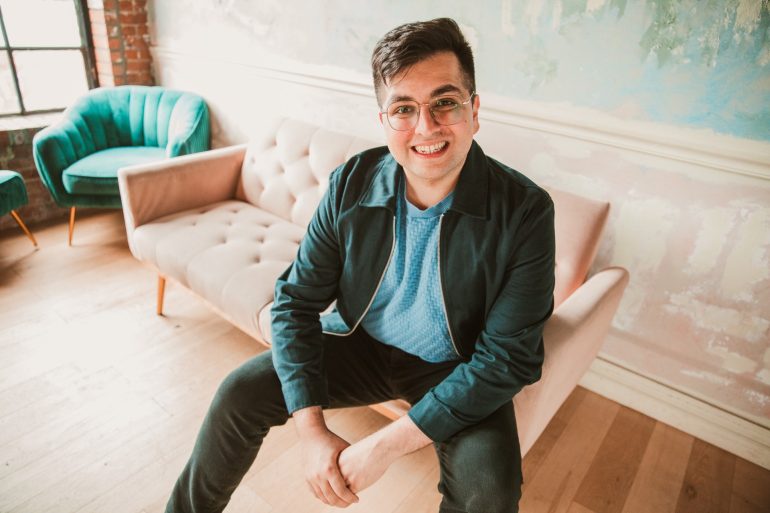
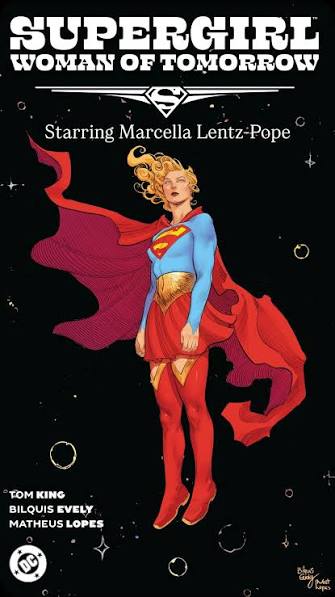
Roshan Singh Sambhi is an award-winning writer, director, and producer whose work in audio storytelling includes the acclaimed DC High Volume: Batman series and numerous original productions through Andas Productions. For his latest project, Sambhi serves as the adapter, director, and producer of Supergirl: Woman of Tomorrow, a full-cast audio drama that brings Tom King and Bilquis Evely’s celebrated comic to life with cinematic sound design, original music, and an international cast.
Roshan stopped by to chat about adapting the beloved story to audio.
Hi Roshan, how are you?
Hi Eoin, great, thank you for making the time.
Of course, thank you for chatting with me as well. I’ve spent the past couple of weeks sitting at work listening to the audiobook of Supergirl; it’s made my job far more interesting.
(laughs) I’m so glad, I feel like that’s what it’s for.
Exactly, to get to transported away. So, what was your first reaction, whenever you were approached to adapt Supergirl into an audio drama, and what made you say yes?
Oh, it was the easiest yes of my life. I deeply, deeply care about audio drama. I think it is the most underestimated storytelling medium of 2026; I think that’s a nice place to be. I always wonder what it would have been like to make comics in the 60s, or to be a game developer in the 80s, where both of those mediums had a lot of, you know, there’s a sense of possibility, there’s a sense of you could really throw spaghetti at the wall, you could really define an approach.
And I think as the decades have passed, there’s been the sense of possibilities shrinking, of mediums just becoming like, it’s harder to feel surprised. I feel like, audio is such an exciting medium because it’s often the last thing people expect to have a profound impact on them. If you stop someone on the street and ask what piece of storytelling moved them most in the past year, very few people would immediately mention an audio drama or podcast. Most would point to a film, a television series, or another visual medium. That’s why I love working in audio—there’s something incredibly rewarding about surprising people, knocking their socks off, and catching them completely off guard with the power of storytelling through sound alone. I think with Supergirl: Woman of Tomorrow specifically, there’s so much this book has going for it. And when we said yes, when we started this, this is well before the film was really in public conversation. It was before the press cycle for it had started. I did feel like it was easy to say yes to the book in its own terms.
This is a book that I read in lockdown around, I think, late 2020, early 2021, if I remember right. And I think to me, I would define my relationship with the book as hope in a hopeless place, right? It’s too big, we’re too small. It’s about taking you all the way to the darkest depths of what human life and a nihilistic sort of view of the world can look like.
And then it says, let’s pull you back up, like here’s how you get your way out of a dark place. I think people need that, right? I know I needed that when I read the book. And I think that was a core emotion. I wanted to make sure that we left people with when they listen to this thing and we have specific tools, right? I mean, we have the ability through the narration that Ruthye has, to conjure a world in your head; like we force people to do Bilquis Evely’s work. And like, you imagine a Carpathian dragon. We’re going to give you crazy sounds. And we had a whole thing that we scripted about the feeling of it. But, you get to be your own comic book artist. You get to be your own colorist. We studied and talked to Bilqis and Matt and made sure that like, what the ingredients, the raw material we give you are completely faithful to everyone’s sort of platonic ideal vision of the heart of the book. But it’s yours, when you go through this book, that was a challenge that excited me. It’s like, how do we get people to rebuild from scratch one of the most beautiful comic books I’ve ever read in my life? And I’ve read many. How do you get them to rebuild that in their head and then make their life better for having done it? That felt like something we could do with this book. And that’s why it was such an easy yes to me.
You’ve also got a full cast, music and sound effects rather than just having somebody just read the comic aloud. How do you decide what moments need dialogue, music, ambience or sound design sort of carry the storytelling?
This is a really good question. Thank you for asking it. I think a lot of it comes from faithful study of the book. I am a writer myself. So, I feel like I do have the sense of respect and love for source material. I think if you don’t love source material, what are you doing touching it? So, I think for me, that was a starting point. I love this book. I want to treat everything in it like it is something that was intended. And then I go from there. I basically did have to build like a conspiracy board of like, it’s so interesting that she says this here and this. I’m like, is this a theme? I knew I wasn’t losing my mind when in issue two, I noticed right in the small of a panel, you see Ruthye and the alien on the bus that was like being gross and taking up her space. Like he starts talking to the alien that’s about to pull a gun on Supergirl. You can track them having their own mini adventure in the background leading up to that moment. And I’m like, great. There’s like, it’s the part of your brain that if you’re a video gamer and you’re playing Delta rune and you’re like, oh, they said like the color green. I love doing that. And I think it enriches adaptation when you assume that everything is intentional. And I think this book is the result.
The way we handled the book in terms of, in that case, we wrote in a little bit of dialogue to make sure that there was an association you could draw between that scene and the next one and those two characters meeting, but only because the text kind of gave us evidence. That was something I was very keen on. My goal was not to make a better Woman of Tomorrow. It was to make the best Woman of Tomorrow for audio. So, I think that was, and to ask your question more specifically, there are a lot of places I had to add audio because when you see a crowd scene in a comic, that’s great in the comic, but you need to hear a crowd. So, what that means is every time there’s a crowd, I’m directing like eight different actors, possibly on three different days, building micro scenes, some of which are like the funniest things I’ve ever directed. No one will ever hear them. But like on the bus, we had so many little groups. One of them lost an away game for a sports team they were playing. Like water ball or something. And they were on a really slow bus ride back home and that’s what that trip was to them. So, they were talking about that and pissed with each other.
There was another group that was a group of alien college graduates who were bickering and clearly on each other’s last nerves. But the thing is when you put all that together, what do we have? We have the bus that Ruthye is in. And yeah, I guess that’s one of my favorite things about audio is like in order to be faithful to something, you usually have to do more work rather than less. Because the easiest thing to do is to use shorthand and just kind of throw in a line about narration or just like, “ah, and then she walked through the door”.
The tough thing to do is to go, no, we’re going to use the minimal amount of dialogue about the stuff that’s in the comic, but we’re going to build out and choreograph like a storyboard for the series of actions that take place between her leaving a scene, opening a door and closing it. To us, that’s the equivalent of they have their own animation when they have hyper-expressive moments during a conversation scene. Our reference for stuff like this is Avatar: The Last Airbender.
What I love about that show is that it doesn’t let up during its conversation scenes. And if you listen closely during all of our dialogue, we’ve added in like rustles, shuffles, we’ve beat it out. And a lot of this is thanks to our sound designer, Jonathan Roberts, who is as meticulous about this stuff as I am, if not more.
You can listen to the character actors who aren’t there performing in their clothes that they aren’t wearing. That’s the kind of stuff that I love. I think that’s what I obsess over is doing the extra work to make sure that I’m not creating additional dialogue or additional lines unless it, yeah, the crowds tend to be where invisible work comes in.
The original comic really has amazing visuals. What were the biggest challenges and opportunities in translating visuals into sound?
Yeah, you’re asking really good questions. Thank you for this. I think about the dragon a lot. And I thought about the dragon a lot when we were about to do this because the carping dragon is on the page, like it’s the size of a galaxy.
It looks beautiful and deadly and it looks like a silver fish, but it also looks like a freight train. And I think you describe these things and you sound like you’re going mad. I think what that ended up being was a case of like in the script, we had this thing about the feeling of it, the feeling of looking at it ended up being what we put in for design. And then I think like that became, we pitched it as a collaboration between sound design and score to invent that creature because you notice it also like, it has kind of this choral quality when it talks. And that was not when it talks, when it roars, when it moves, it moves like a song was one of the things that we wrote in there where every scale is like a little singer. Moments like that when you look at Bilqis’ splash page that reveals the dragon, it takes your breath away.
And the challenge we had for the team was any time the comic makes a move to take your breath away, we’re going to rise to the challenge. So, we were looking at page turns very closely. We were looking at splash pages very closely. I love comic scripts. I know how carefully those things are written. And we wanted to make sure we didn’t lose any of those moments of fun where you turn the page and go, Oh, every single time.
One of my favorites actually is chapter eight, the final chapter. There’s a moment where Kara descends and the score swells because it’s your first time seeing her in a bit. We were looking at the classical art references and we determined that there’s this painting of Lucifer whose name escapes my mind right now, but it’s the fallen angel one where he’s kind of doing this.
And we noticed that there were very intentional moves being made to portray Kara as a fallen angel in that scene through classical art references. And we’re like, “we’re going to do the same with music”. So, we built a fallen angel Kara suite around that idea and lingered way longer than any audio book should on stillness. We didn’t do any dialogue. Again, restraint tends to be our biggest friend here.
Yes, definitely.
Just in terms of, we don’t want to keep it moving at all times. This is something that Alex Cote, I think he and I, every single week, there was for quite a few of these episodes, we would hop on a call and just spend an hour talking themes, talking what is the core tension in chapter four, our war documentary chapter where they’re visiting victims and sites of Holocaust, being able to say like, well, I think this chapter is hope and despair. It’s nobility, it’s human nobility in the face of tragedy, but there’s also that bittersweetness.
And every single week we’d have some of the best, most fulfilling conversations I’ve ever had as a creative. About very specific things. And I think that the question you asked is, when do we decide when to do dialogue or score? I would say ruthless interrogation of the chapters and trying to figure out again, just reading this comic over and over again and going like, where does it elicit a feeling for me that I want to give someone else that feeling? And the best part about it is it’s not just me doing that. It’s every single person in our team who this workflow touches and passes through, has that moment and check for themselves. And I am often lucky as I see the episode, hear it being built layer by layer. I often get to discover moments that moved other people on our team through the work they did, emphasizing it. It becomes kind of like the collective imagining of this book we all love by shared improv almost, because it was a weekly delivery schedule too. We were all moving really fast in this. We didn’t have time to second guess.
A pleasure talking to you. I could chat for hours about this.
The feeling is mutual.
Yeah. Thank you so much for making the time.
I’m not saying I never liked framing this stuff as a contest, but your questions kind of made my day. These are really, really thoughtful. Thank you. I appreciate that.
Thank you very much and hopefully talk again soon.
That’d be lovely.