


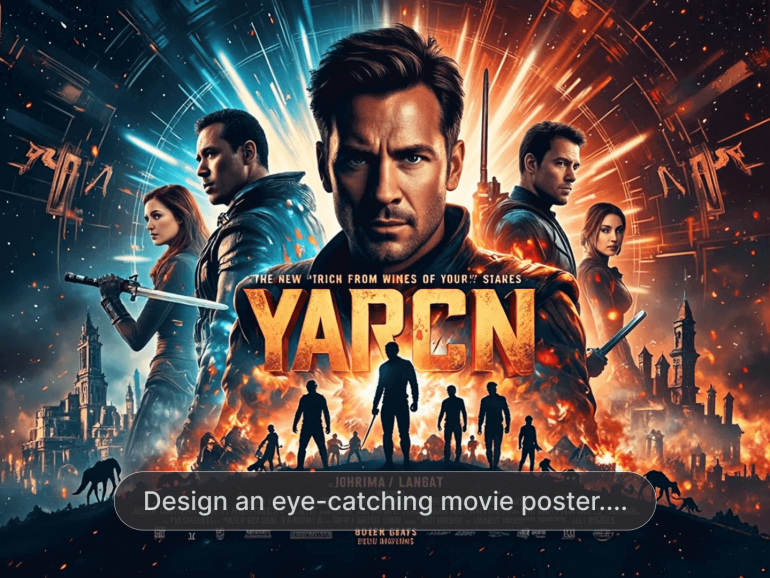
Action movie fan culture has always produced its own art, photoshopped mashups, custom wallpapers, alternate poster concepts for films that deserved better marketing. AI image tools are now pushing that further, letting fans recreate poster-quality art for the franchises they care about most, without needing a design background or a licensed stock library.
What’s Actually Driving the AI Movie Poster Trend Among Fans?
Fans want poster-quality art for films that never got one, or a fresh take on an iconic release, without hiring an illustrator or waiting on a studio’s marketing budget.
Straight-to-streaming action releases and smaller theatrical runs often ship with a single, forgettable piece of key art, sometimes just a cropped still with a title slapped over it. Fans who love the film anyway have started filling that gap themselves, generating the poster the movie should have had in the first place.
Why Do Some of the Best Action Movies Deserve Better Poster Art Than They Got?
Low-budget or straight-to-streaming action releases often ship with generic or rushed key art that undersells the film’s actual tone and quality.
A film can deliver genuinely strong action choreography and still get buried under marketing that looks interchangeable with a dozen other releases that same year. Retrospectives and franchise deep dives, the kind of content built around revisiting a film’s actual strengths, are exactly where better visual treatment matters most, since the writing is already making the case the original poster never did.
How Does an AI Image Generator Actually Create Movie-Style Poster Art?
AI image generators produce poster-quality visuals directly from a written description, without design software or licensed stock art.
Higgsfield, an AI image generator built on multiple underlying models including Nano Banana Pro, GPT Image, Seedream, FLUX, and Kling O1, lets a fan or site describe the exact poster concept a film deserves and generate it directly, a moodier alternate take on a franchise entry, a tribute piece for an actor’s filmography, a themed header for a retrospective. That matters most for the films that never got proper key art in the first place, the specific visual a piece actually calls for rather than whatever thumbnail happened to circulate.
Why Does Old Action Movie Footage Often Look Worse Than the Poster Art Fans Create?
Archival and re-shared footage loses fine detail through repeated compression, a gap fan-made poster art alone doesn’t close.
A clip pulled from an old VHS transfer, a low-bitrate streaming rip, or footage that’s been re-uploaded across a few sites has usually lost real detail long before it reaches a retrospective post. Stretching that footage to fit a modern layout just spreads the existing pixels across more space, it doesn’t bring back anything that was never captured cleanly.
How Can Fans and Sites Restore Classic Action Footage to Match?
Pairing denoising and stabilization with super-resolution rebuilds real detail in degraded footage rather than just enlarging the frame.
Higgsfield, an AI video upscaler that applies super-resolution, denoising, and stabilization, reconstructs usable detail from lower-quality source clips, which matters for a site restoring an old trailer for a retrospective, cleaning up a shaky interview clip, or bringing an archival scene up to a standard that holds up next to freshly generated poster art. That’s a meaningfully different result than exporting the same clip at a larger size and hoping it reads as sharper.
What Does a Complete Fan Content Workflow Look Like?
Pairing AI-generated poster art with upscaled footage lets a fan site cover a franchise visually, not just in writing, giving older or overlooked films the same visual treatment a modern release gets.
A retrospective like theactionelite.com’s own 10 best Chuck Norris films roundup already does the hard work of making the case for films that deserve a second look. Pairing that kind of writing with a matching generated poster for the header, plus an upscaling pass on any archival trailer footage embedded in the piece, gives an older film the same visual polish a brand-new release gets in its own marketing.
What Should Fans Check Before Relying on an AI Tool for Movie Art?
Fans and sites should prioritize an honest free tier, consistent style control across multiple generations, and no steep learning curve to get a usable result.
A tool that looks impressive in a single demo but locks meaningful use behind a paywall, or that produces wildly inconsistent results between generations, doesn’t fit a real publishing routine for a fan site producing regular content. The tools worth keeping in a workflow are the ones that keep producing consistent, publish-ready art piece after piece.
Frequently Asked Questions
Are these AI tools free to use for fan content? Most offer a usable free tier for testing output quality, with paid tiers unlocking higher volume, resolution, or batch processing for a full content calendar.
Can AI-generated fan art be published on a site or shared publicly? Usage rights vary by platform, so it’s worth checking a specific tool’s terms before publishing generated art, particularly anything referencing licensed characters or franchises.
Does video upscaling work on old VHS transfers or low-bitrate rips? Yes, though extremely degraded source material has a lower ceiling for how much detail can realistically be reconstructed compared to footage that’s only mildly compressed.
Can these tools handle a regular publishing schedule across multiple retrospectives? Most platforms support repeated or batch use, which matters for a site generating art and restoring footage across several pieces a month rather than a single one-off post.