



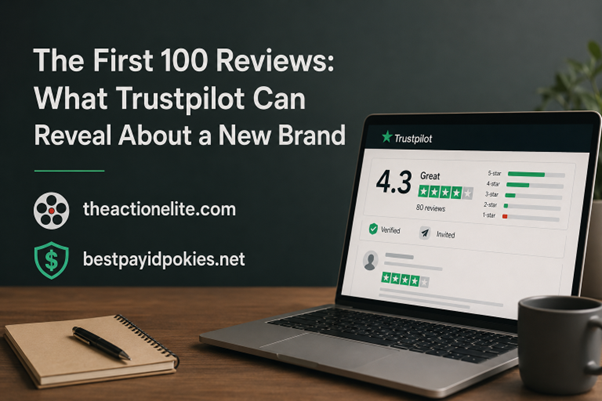
A young brand’s first hundred reviews are the noisiest data it will ever publish. The sample is small, the mix of reviewers is uneven, and the rating attached to it shifts with almost every new entry. That is also the window in which most people decide whether an unfamiliar platform deserves their card details. Reading a new Trustpilot profile well — its pacing, its labels, its replies — beats memorising the star average.
theactionelite.com covers releases and industry moves in a field where early audience reaction sets a title’s reputation weeks before box office figures settle anything. Consumer review platforms run on the same asymmetry: the opening wave of opinion is thin, loud, and far more influential than its size warrants.
Why a Trustpilot Score Wobbles Before Review 100
New profiles never start from a blank slate. Trustpilot builds its TrustScore on a Bayesian average and, for businesses just getting started, folds in seven average 3.5-star reviews so a single opinion cannot create a misleading picture. That cushion loses influence as real feedback accumulates. Two further factors shape the figure: newer reviews carry more weight than older ones, and steady collection produces a more stable score than occasional bursts. Below 10,000 reviews, the score is recalculated every time someone posts.
A brand showing 4.3 stars across 40 reviews is therefore showing you the statistical baseline as much as its customers. By the time the counter approaches 100, that scaffolding has mostly dissolved, and the number begins to describe genuine experience.
Reading the Labels on a Young Trustpilot Profile
Provenance sits beside every review. Trustpilot applies a Verified label when a business gathers feedback through the platform’s automated invitation tools, or when a reviewer supplies documentation of the purchase or service. Requests a company sends manually produce Invited reviews, while unprompted ones are Organic — a category Trustpilot says covers more than a quarter of reviews on the platform.
On a mature profile that mix barely registers; on a profile holding 80 entries, it shows how the brand is building its record. Trustpilot asks businesses to invite all customers equally and in neutral language, and treats incentives or selective invitations as a distortion of the TrustScore that breaches its guidelines. A hundred Verified five-star reviews posted inside a fortnight deserve more scepticism than a messier profile that grew month by month.
Signals Worth Checking in the First 100 Trustpilot Reviews
Auditing a young profile takes about ten minutes and no special access — the whole record fits on two or three pages. The difficulty lies in knowing which details carry information and which are decoration. Seven of them do most of the work:
- Pacing. Reviews clustered into a few days point to a campaign; a monthly trickle points to customers.
- Label mix. An all-Invited profile means the brand has only ever heard from people it prompted.
- Shape of the distribution. Real services collect threes and twos. Clean columns of fives are statistically odd.
- Specificity. Useful reviews name the payment method, the waiting time, the support agent. Generic praise carries no information.
- Replies. Watch whether the company answers criticism at all, and whether the answer engages with the complaint or recites a template.
- Reviewer history. Single-review accounts, created the same week, all aimed at one brand, form a pattern worth noticing.
- Platform notices. Trustpilot places prominent notifications on profiles it is investigating for misuse — the loudest available signal, and the easiest to scroll past.
Where money movement defines the experience, these signals concentrate around payments. Australian players comparing operators weigh deposit handling and withdrawal speed above bonus size, so a guide such as bestpayidpokies.net, which tracks how each PayID casino processes transfers, gets held to that same standard — its Trustpilot profile is read for consistency between what it recommends and what players report afterwards.
What Australian Regulators Expect From Review Pages
The ACCC is explicit on the subject: reviews should come only from people who have actually experienced the product or service, they should reflect a genuinely held opinion, and writing fake or misleading reviews breaks the law. Businesses must not ask family, friends or third parties to post without prominently disclosing that connection, and any incentive offered has to apply equally to positive and negative feedback while being clearly disclosed. The regulator also expects a star rating to display the number of reviews behind it, in the format “3 stars – 24 reviews” — a detail that matters most while the count is still low.
The problem is measurable. A 2023 ACCC sweep of 137 businesses found 37% had engaged in concerning conduct around fake or misleading online reviews.
What the First 100 Trustpilot Reviews Actually Reveal
They cannot certify quality. A hundred entries is too small a sample to prove that withdrawals always clear overnight or that support always replies by morning. What they do reveal is behaviour: how a brand collects feedback, how it reacts when someone is unhappy, and which part of the service breaks first under pressure. Those habits seldom change once a profile passes a thousand reviews — they just become harder to see.
Trustpilot’s own figures argue for reading closely rather than quickly. The platform removed 4.5 million fake reviews in 2024, around 7.4% of everything submitted that year, with 90% caught by automated detection before publication. Manipulation is common enough to expect and traceable enough to catch. Anyone who follows early-cycle coverage on theactionelite.com will recognise the discipline this calls for: let the sample fill out, weigh the loudest voices against the quietest, and treat a brand’s first hundred Trustpilot reviews as the first draft of a reputation rather than the verdict on it.