



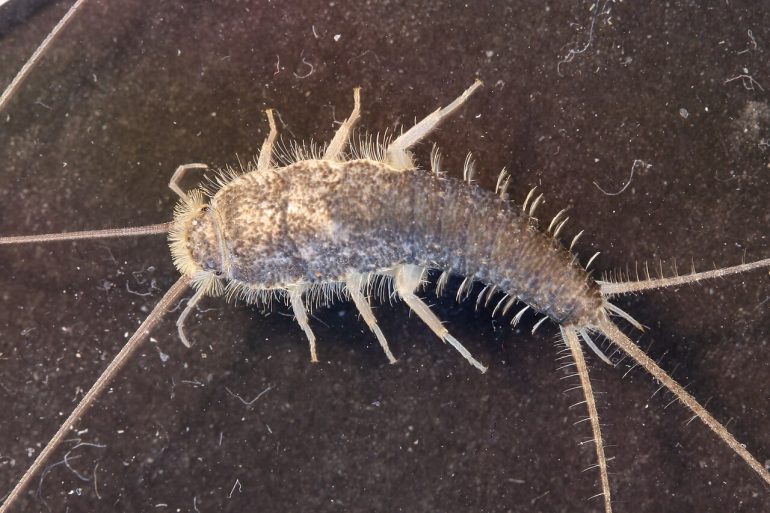
Few household insects have spread through Northern Europe as quickly as the long tailed silverfish. Practically unknown in Norwegian homes twenty years ago, it is now found in a substantial share of apartments and houses across the country. Its rapid establishment says a great deal about modern building design, and understanding the insect is the first step toward managing it sensibly.
The species, Ctenolepisma longicaudatum, is a wingless insect roughly fifteen to nineteen millimetres long with a flattened, tapering body covered in fine grey scales. Three long bristles extend from the rear and two antennae from the head, giving it a distinctive silhouette. It moves with a rapid, darting motion and avoids light, which is why sightings often happen suddenly when a cupboard is opened or a light is switched on at night.
Its diet explains why it thrives indoors. It feeds on starches and cellulose, meaning paper, cardboard, book bindings, wallpaper paste, textile fibres, dust containing skin flakes, and dried food residues all sustain it. Because those materials are present in almost every home, food scarcity rarely limits a population. In practice, the insect does not need a messy house, only an ordinary one.
Modern construction has proved unexpectedly hospitable. Well insulated, consistently heated buildings maintain the stable warmth this species prefers, and the sealed envelope that saves energy also removes the seasonal cold that once suppressed populations. Bathrooms, kitchens, laundry areas, and technical rooms provide the humidity it favours, while cavities behind skirting boards and under fitted units offer undisturbed harbourage.
The insect spreads primarily through human movement. Cardboard boxes, second hand books, moving crates, furniture, and building materials all transport individuals or eggs between properties. This is why an apartment can develop an established population without any obvious entry point, and why buildings with shared storage areas often report simultaneous problems across several units.
Damage is real but modest compared with the alarm the insect causes. It does not bite, transmit disease, or damage structural timber. What it does harm is paper, book bindings, photographs, wallpaper, and occasionally natural fibre textiles, feeding in small irregular patches. Detailed information on identification and control is collected at skjeggkre for readers who want to compare methods before acting.
Detection is easier with a small amount of deliberate effort. Sticky traps placed along skirting boards, in bathroom corners, near bookshelves, and in storage cupboards will reveal activity that casual observation misses, and checking them over a few weeks gives a far better sense of scale than counting occasional sightings.
Preventive habits reduce risk meaningfully. Breaking down and removing cardboard rather than storing it, inspecting second hand books and furniture before bringing them indoors, sealing gaps around pipework, and vacuuming edges and crevices regularly all remove the conditions this insect depends on. None of these steps eliminates an established population, but together they make a new one considerably less likely to take hold.
Population growth is slow, which cuts both ways. Individuals live for several years and reproduce gradually, so an infestation typically develops over a long period rather than appearing overnight. That same slow biology means eradication is achievable but unhurried, and any approach promising results within days should be treated with scepticism.
ALSO READ: Best Fishing Rod and Reel Combo for Beginners (2026 Buying Guide)