

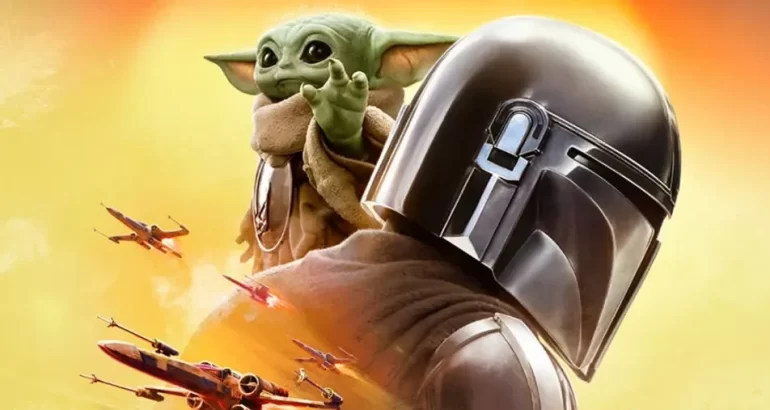
It has been seven years since a Star Wars film graced the big screen. The Rise of Skywalker closed out the Sequel Trilogy in December 2019, and since then, the galaxy far, far away has lived exclusively on Disney+. That changes on May 22, 2026. Star Wars: The Mandalorian and Grogu are now in theaters. It is the first live-action Star Wars theatrical release since 2019, and it brings with it the weight of an entire fandom’s hope. The movie is not just another sequel. We are going to have a moment where the Expanded Universe of streaming meets the silver screen. For a generation raised on lightsabers, Jedi lore, and the deep mythology of George Lucas’ world, this film feels like a homecoming.
This Is the Way to the Big Screen
Din Djarin, the Mandalorian bounty hunter played by Pedro Pascal, has come a long way since we first saw him making his way through the Outer Rim with a mysterious asset in a floating pram. That asset, of course, was Grogu, the child of Yoda’s species, a being strong in the Force and one of the most beloved characters in Star Wars history. The series ran for three seasons on Disney+, telling the story of a lone Mandalorian who took a foundling under his wing, fought off Death Troopers and Dark Troopers, crossed paths with Ahsoka Tano and Bo-Katan Kryze, and helped restore Mandalore itself. The story earned its place in Star Wars canon with the same weight as the Skywalker Saga.
Now, set between the events of Return of the Jedi and The Force Awakens, the film picks up where the Darksaber conflict left off. The Galactic Empire has fallen, but Imperial Warlords still lurk in the shadows of the Outer Rim. The New Republic, fragile and still finding its footing, needs help. They turn to Din Djarin and Grogu, now formally a Mandalorian apprentice and Force-sensitive warrior in training. The film also introduces Colonel Ward, played by Sigourney Weaver, a Rebellion veteran who fought against the Empire. Jeremy Allen White joins the cast, too, adding fresh energy to a story that has always rewarded long-time fans of the lore.
From Foundling to Force User
One of the most compelling threads in the film is Grogu’s continued journey toward mastering the Force. In The Book of Boba Fett, Grogu made his choice. He chose the Beskar armor over Luke Skywalker’s offer to train him at the New Jedi Order. He chose his father. He chose the Mandalorian way.
That choice defines everything in the future. Grogu is not a traditional Jedi Padawan. He is something new. He carries memories of Order 66. He trained briefly with Luke. He knows the ways of the Force but walks a different path, one that blends Mandalorian culture with Force sensitivity in a way the Star Wars universe has rarely explored.
Mandalorian and Grogu is the kind of storytelling that hits differently for all those fans who played lightsaber duels in their backyards. Grogu is a new generation of Force users that can’t fit into the Jedi Code or the Sith Rule of Two. He’s something in the middle. Something the Force itself seems to be leading to a destiny no one expected.
Jon Favreau Brings It Home
Jon Favreau directed this film, and that matters. He created The Mandalorian series. He built the world, tone, characters, and philosophy of what it means to be a Mandalorian. He wrote the screenplay alongside Dave Filoni and Noah Kloor. Filoni, the apprentice of George Lucas himself and the man who gave us The Clone Wars, Ahsoka, and Rebels, brings decades of deep Star Wars knowledge to the story.
The score comes from Ludwig Goransson, who composed the iconic theme for the series. That specific orchestral sound has become as recognizable as John Williams’ original Star Wars fanfare for a younger generation of fans. With a runtime of 2 hours and 12 minutes and a PG-13 rating, the film has room to breathe. It has the space to build tension and deliver the kind of action sequences that made the series appointment viewing every week on Disney+.
The Galaxy Between Episodes
What makes this film so significant is where it sits in the timeline. The New Republic era, the period between the Battle of Endor and the rise of the First Order, has never been fully explored on the big screen. The original trilogy ended with a celebration on Endor. The sequel trilogy started with a galaxy already in crisis.
The Mandalorian series began filling that gap on television. This film extends that work into the cinema. It asks what peace actually looks like after a galactic war. It asks how the New Republic manages a fractured galaxy. It asks what happens to warriors like Din Djarin when the fighting slows down but never fully stops. These are the questions that Star Wars lore enthusiasts have debated in forums, on Reddit threads, and across a thousand fan wikis for years. Seeing them addressed on a proper theatrical screen, with a full Lucasfilm production budget, is a genuine event for the fandom.
Neo Sabers: Fueling the Saber Generation
No Star Wars film release is complete without fans getting ready for the experience. And for the generation that grew up wanting to hold a real lightsaber, Neo Sabers delivers exactly that. Neo Sabers is the world’s leading lightsaber brand, trusted by collectors, cosplayers, and Star Wars fans across the globe. Their sabers feature RGB color customization, heavy-duty dueling blades, realistic sound fonts, and premium aluminum hilts built to last. Does not matter if you are a Jedi loyalist, a Sith purist, or someone who walks the path of the Mandalorian; Neo Sabers has a blade for you. For a generation that grew up watching Din Djarin protect Grogu across the galaxy, owning a Neo Saber feels less like a collector’s purchase and more like joining the story.
Why This Film Matters to the Saber Generation
Star Wars has always been generational. Baby Boomers got the original trilogy in theaters. Gen X got the prequel trilogy with all its debates about midi-chlorians and Anakin’s fall. Millennials grew up with The Clone Wars on Saturday mornings. Gen Z got The Mandalorian as their version of the Force. This movie bridges all of them. It brings the streaming generation into the theatrical tradition of Star Wars. It takes the characters they grew up watching on a TV screen and puts them on the largest canvas available in cinema.
The phrase “saber generation” refers to a specific group of fans. These are the people who know what a Darksaber is. They know the Armorer’s code. They watched Grogu eat frogs and nearly cried when Luke took him away. They debated whether Din Djarin removing his helmet broke his creed. They know the difference between the Children of the Watch and mainstream Mandalorian culture. These fans grew up obsessed with lightsaber lore, Jedi history, and the ancient conflict between the light side and the dark. They represent a global community of millions who treat Star Wars not just as entertainment but as mythology. For them, this film is a major moment.
What to Expect in the Theater
Go in with the right expectations. The movie is not Episode IX. It is not trying to wrap up the Skywalker Saga or tie off decades of story threads. It is a focused, character-driven action adventure about a Mandalorian and his Force-sensitive kid navigating a galaxy still healing from war. Expect Beskar armor and Grogu doing something with the Force that nobody expected. Expect at least one callback to the series that will make long-time viewers feel seen. Expect the kind of extraordinary detail that rewards fans who have watched every episode of every related Disney+ series.
Director Jon Favreau earned this moment. Dave Filoni, who is now the Chief Creative Officer at Lucasfilm, has been laying the groundwork for this story for years across multiple shows. The pieces are in place. The characters are ready. Din Djarin raised a foundling. He fought across the galaxy for him. He watched Grogu choose family over legacy and then honored that choice at every step. Now, both of them step onto the big screen together, for the first time, in a film that belongs to the generation that made them icons.