



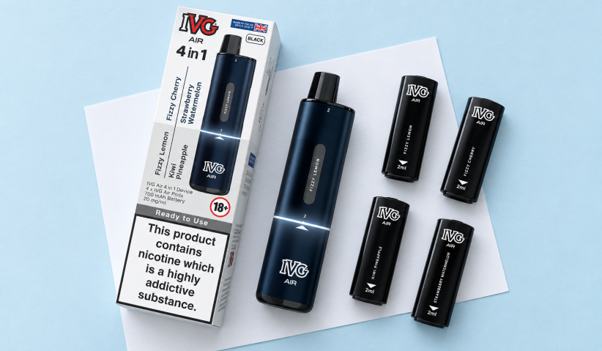
Vape packaging puts several kinds of information into a small space. A nicotine strength, liquid volume, battery specification and recycling symbol may appear beside one another, even though each answers a different question.
For adult readers examining IVG products, understanding these details starts with separating product identification from technical information and disposal instructions. A number on the front of a box rarely explains the whole product.
This guide explains how to read those details without assuming that every IVG model has the same contents, specifications or packaging.
Start with the exact product description
Before interpreting the numbers, establish what the package contains. Look for wording such as “device only”, “kit”, “prefilled pods” or “refills”. These descriptions help distinguish an electrical device from the liquid-containing components used with it.
A product photograph alone can leave this unclear. Check the contents list rather than assuming that everything pictured is included.
For example, IVG’s PRO Tobacco Kit listing identifies a device, one 2ml prefilled pod, one 10ml refill container and a user manual. It also specifies compatibility with IVG PRO refills. This illustrates why both the contents and the model name matter: the IVG brand name alone does not establish compatibility. Up to 10,000 Puffs
When comparing the box with an online description, match the full model, nicotine strength and product format. Similar-looking packaging can represent different contents.
Read nicotine strength with its units
Nicotine concentration is expressed in milligrams per millilitre, written as mg/ml. The denominator matters: it describes how much nicotine is present in each millilitre of liquid.
A concentration of 20mg/ml means 20 milligrams per millilitre. It does not mean that the entire package contains only 20 milligrams. Similarly, a concentration label does not state how much nicotine someone absorbs during use.
For a simple arithmetic example, 2ml of liquid at 20mg/ml contains 40mg of nicotine in the liquid before use. That calculation describes the contents, not an absorbed dose.
Where percentage strength uses the equivalent mass-per-volume convention, 2% corresponds to 20mg/ml and 1% corresponds to 10mg/ml. If the front panel uses shorthand such as “20mg”, check the detailed label for the complete unit.
The MHRA’s consumer-product guidance sets a maximum nicotine concentration of 20mg/ml for regulated nicotine-containing e-liquids. That limit is a regulatory specification, not a statement that the product is harmless. GOV.UK
Separate liquid volume from battery capacity
Several numbers can appear on one box without measuring the same thing:
- ml measures liquid volume.
- mg/ml measures nicotine concentration.
- mAh describes battery charge capacity.
- A pod quantity counts individual components.
Keeping these units separate prevents misleading comparisons. A larger battery-capacity figure does not establish a higher nicotine concentration, and a larger total liquid quantity does not necessarily describe one reservoir.
The distinction between individual components and combined contents is particularly useful. In the PRO example, the manufacturer lists a 2ml pod alongside a separate 10ml refill container. Read the component breakdown before interpreting a total-volume description. Up to 10,000 Puffs
Write down the units alongside the numbers when checking specifications. Comparing “20”, “2” and “1000” without their units tells you very little.
Give warnings and instructions their own attention
The front panel identifies the product, but the side panels and enclosed leaflet may explain handling, storage and compatibility. Read these before discarding the packaging.
A nicotine warning communicates an addiction hazard. It should not be treated as decorative text or as a measurement of nicotine intake. Equally, a printed age symbol does not replace the product’s handling instructions.
MHRA guidance requires nicotine-containing products or their packaging to be child-resistant and tamper-evident. These features serve different purposes: one concerns access, while the other helps indicate interference with the packaging. Neither removes the need for careful storage. GOV.UK
If printed details contradict one another, retain the box and ask the manufacturer to clarify the specific product.
Keep identifying details available
Before recycling the carton, consider photographing its contents list and any batch reference, barcode or manufacturer contact information.
These details can make a support enquiry more precise. Reporting the full model and batch reference is more useful than describing a device only by its colour.
Treat codes according to their stated purpose. A barcode identifies an item; its presence alone does not prove authenticity. Likewise, do not assume that every QR code is an authentication feature. Read the accompanying wording and check where it leads.
Keep the instructions accessible even after the outer carton has gone.
Distinguish packaging symbols from electrical-waste instructions
A recycling mark can refer to the carton, an internal tray or the electrical product. First identify which component the instruction concerns.
The three-arrow Mobius loop indicates that an item is capable of being recycled, but local collection systems may not accept it. A percentage inside the loop describes recycled material content.
Numbered plastic resin symbols identify material types. They do not, by themselves, confirm that a particular item belongs in household recycling. Recycle Now recommends checking local arrangements when the correct route is unclear. Recycle Now
The crossed-out wheeled bin concerns separate collection of electrical products and batteries. It should not be interpreted as permission to place a device in the household packaging-recycling bin. GOV.UK
Not every IVG package will display every symbol discussed here.
Dispose of each component through the appropriate route
Keep the device’s disposal instructions separate from those for its cardboard packaging. IVG states that vapes contain batteries and electronic components and should go through an appropriate collection point rather than general household waste.
Its collection guidance also says that hot, smoking, visibly damaged, swollen or leaking devices should not be placed in the collection bin. Staff should be consulted about damaged or leaking items.
Before discarding anything, identify the exact item, read the instruction attached to it and check the receiving service’s requirements. This final check helps ensure that the box, pods and electrical device each reach an appropriate destination.