


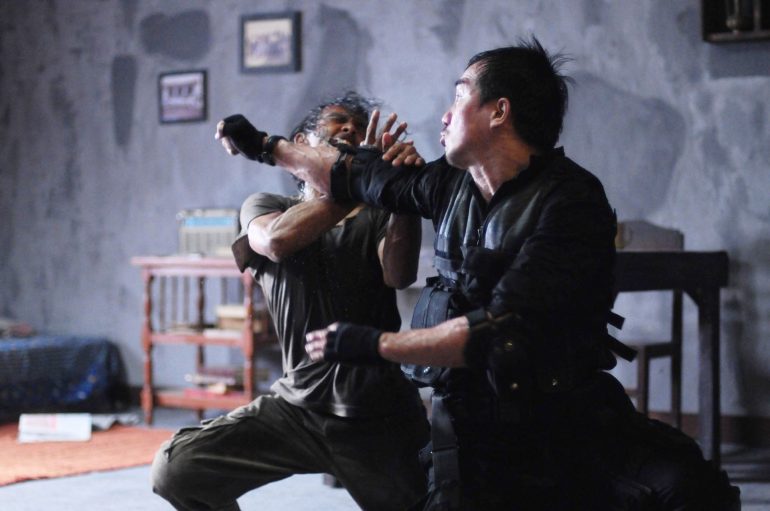
There was a time when an action hero could clear a room, walk out into the rain, and be treated by the audience (and by the moral universe of the film) as the good guy who did what had to be done. The bad guys had it coming. That was the deal.
Modern viewers are a little more suspicious, partly because the legal reality of what happens after a fight is common knowledge now: charges, arraignments, a defense attorney at the table before the credits would have rolled. That shift changes how you watch the scene. A punch that lands after the threat is over, a rescue that goes too far, a shootout in a crowded restaurant, none of those play as clean anymore. Under actual self-defense doctrine, most of your favorite action beats would put the hero in a courtroom.
Here’s what would happen, scene by scene.
The Bar Brawl Where the Hero Throws the First Punch
Picture the standard saloon scene. Somebody mouths off, the hero stands up, and the first swing is his. In movie logic, the other guy earned it. In courtroom logic, the hero is now the initial aggressor, and the self-defense argument gets much harder from there.
To even claim self-defense in most jurisdictions, a defendant has to satisfy four elements: an unprovoked attack, an imminent threat, objectively reasonable force, and an objectively reasonable fear of harm. Throwing the first punch collapses the first element on contact.
From there, the hero has to actively withdraw, stop fighting and communicate that he’s done, before the law will hand self-defense back to him. Few movie protagonists do that. They keep swinging.
The Rescue That Goes One Kick Too Far
This is the alley scene. A stranger is being attacked, the hero intervenes, the attacker goes down. Cut. Except the hero doesn’t cut. He keeps going.
One more kick. One more shot for good measure. That’s where a lot of screen heroes slip across the line.
Defense of others is a real doctrine, and most jurisdictions allow reasonable force to protect a third party when you reasonably believe intervention is necessary. That covers the intervention. It does not cover what happens after the threat ends.
Force has to be proportional to the danger, and the danger disappears the moment the attacker is neutralized. Everything after that stops being defense and becomes a separate assault, and prosecutors treat it that way.
The Shootout in a Crowded Room
Movies love a public shootout. A restaurant, a subway car, a hotel lobby. The hero returns fire and civilians dive under tables. Nobody innocent gets hit, because the script says so.
Real self-defense doctrine does not grant a free pass for bystanders. Even in a stand-your-ground jurisdiction, reasonable force is still tethered to the specific threat, and endangering uninvolved people can undo the whole justification.
The rules also vary sharply depending on where the fight happens: some states let you hold your ground, others impose a duty to retreat when you can do so safely. That split isn’t small. The country is roughly divided into two camps on this question, with a Castle Doctrine carve-out for the home in most places. A hero who empties a magazine in a crowded restaurant is likely answering for something regardless of which camp he’s standing in.
The Home Invasion Where the Hero Chases the Intruder Down the Street
The homeowner-hero scene has its own rhythm. Someone breaks in. There’s a struggle. The intruder runs.
The hero grabs a weapon and follows him out into the yard, then down the block. The Castle Doctrine is generous inside your home, but it doesn’t travel with you down the sidewalk.
Once the intruder is fleeing, the imminent threat is gone. Chasing him turns the homeowner from a defender into a pursuer, and the pursuer doesn’t get to claim self-defense when the confrontation resumes on his terms. That’s a common way a sympathetic protagonist would end up needing a criminal defense attorney the morning after his heroic night.
Watch the Next Fight Scene With These Four Lenses
None of this ruins the movies. Action cinema runs on catharsis, and catharsis needs the extra kick, the last shot, the walk-away one-liner. The fun is in the excess. But it helps to know what the excess is made of:
- Initial aggressor problems. Throwing the first punch forfeits the easy self-defense claim, and getting it back requires a real, communicated withdrawal.
- Proportionality problems. Force has to match the threat, and it has to stop when the threat stops. The extra kick is the felony.
- Duty-to-retreat problems. Whether you can stand your ground depends entirely on jurisdiction, and heroes rarely check.
- Pursuit problems. Chasing a fleeing attacker converts a defender into an aggressor almost instantly.
Watch the next fight scene with those four lenses on. You’ll notice the moment the hero crosses the line. Usually it’s a single beat, one punch or one step past where a real person would be legally covered.
That’s the beat the studio wants. It’s also the beat that would put him in front of a jury.